Today, the goals of customer relationship management determine whether companies can build long-term customer relationships or remain stuck with fragmented customer data and isolated processes. There are many companies that have a customer relationship management (CRM) system, but few have a CRM strategy. The difference doesn’t lie in the tool, but in the results: Customer loyalty that lasts. Revenue that grows. A customer experience (CX) journey that truly delights. That may sound compelling, but it often fails to deliver results because there is a lack of strategic depth, measurable KPIs, and effective execution. This post explains which CRM goals truly matter today, the common mistakes companies make, and how an integrated CRM/CX platform turns good intentions into measurable results. Topics such as data protection, digital sovereignty, and regulatory security are also critical factors.
22.05.2026
Goals of customer relationship management
Define, measure, and achieve your CRM goals with the right platform.


The most important goals of customer relationship management
Not all CRM goals are equally important. And not all of them are equally urgent. Real-world experience with companies in banking, insurance, retail, and energy & utilities shows that the most critical CRM goals today are those that directly connect customer loyalty and customer experience – and can be measured through clear KPIs. Loyal customers buy more often, recommend more readily, and are less sensitive to price. The Customer Lifetime Value (CLV) rises. Acquisition costs fall. And here is the crucial part: Customer loyalty isn’t created through discount campaigns. It is created through relevance. Through communication that resonates. Through offers that fit. Through service that works before a customer even has a problem.
What is the customer experience (CX) journey? – A definition
A customer experience (CX) journey captures all touchpoints and interactions a customer has over the course of their relationship with a company. In contrast to the classic customer journey, which primarily maps the sequence and order of touchpoints, the CX journey places a stronger focus on the experience itself: It puts customers’ emotions, expectations, and perceptions at every single touchpoint front and center. It therefore reflects the customer’s perspective – from the first moment of awareness through the purchase and into the post-purchase phase – and shows how the customer perceives the company as reflected in emotions, opinions, and experiences.
CX is not to be confused with UX (user experience). Whereas UX focuses on the interaction with a specific product or digital interface (e.g., an app or website), CX encompasses the customer’s overall perception of the brand across all channels and throughout the entire customer lifecycle.
The difference between CRM strategy and CRM software
The CRM strategy defines the direction: Which customers should be addressed and how? Which customer journeys should be created? How do marketing, sales, and service work together?
The CRM software operationalizes this strategy. It consolidates customer data, automates processes, and provides the insights needed for data-driven decisions. Investing only in software without a clear strategic direction leaves potential untapped. And having a strategy without the right CRM/CX platform means failing at execution.
Enhance customer experience and boost customer satisfaction
Customer satisfaction is measurable. Customer experience is everything customers encounter across all touchpoints, from the first interaction to the post-purchase support. The two are closely connected, and both can be managed with the right data.
Key CRM goals in this area include:
- Consistently reducing service response times – for example, cutting the average first-response time by 50 percent within 12 months (from 8 to 4 hours).
- Handling requests and inquiries consistently and across channels – for example, increasing the share of cases resolved seamlessly, without media disruptions, across channels to 80 percent.
- Ensuring personalized communication along the customer journey – for example, raising the share of personalized campaigns to 70 percent and increasing open and click-through rates by 20 percent.
- Proactively addressing customer needs before issues arise – for example, increasing the share of proactive outreach to 30 percent of all customer interactions and reducing churn in this group by 15 percent.
- Increasing conversion rates through targeted, data-driven campaigns – for example, lifting conversion rates above 6 percent through personalized campaigns based on a 360° customer view.
Grow revenue and maximize CLV
Focusing only on new customers means the thinking is too short-term. CLV shows how much revenue a single customer generates over the entire relationship. Those who understand this value and actively increase it think in relationships rather than transactions.
AI-powered next best actions reveal which offer resonates at the right time. Churn-prevention models identify early who is at risk of leaving. The result? Higher conversion rates, lower churn, and more revenue from the existing customer base.
Drive greater efficiency in sales and marketing
How efficiently do Sales and Marketing work together? And how much time is lost to manual tasks that could be automated?
A well-designed CRM system reduces inefficiencies, automates routine processes, and creates a shared cross-departmental view of the customer. Sales and marketing alignment – the close coordination of both teams around common goals and customer data – is a key success factor. The result? Shorter sales cycles, higher conversion rates, and marketing that truly hits the mark.
Make CRM goals specific and measurable
“Customer loyalty” and “customer experience” may sound abstract. But they aren’t when the right KPIs are in place. A strong example of a KPI that connects both is the First Contact Resolution Rate (FCR). It measures whether an issue was fully resolved during the first contact, with no follow-up questions, no handovers, and no additional effort. This makes it the crucial quality dimension that complements the First Response Time (FRT): not just how quickly a team responds, but whether the problem actually is resolved. Organizations that consistently manage both KPIs improve customer satisfaction and service efficiency at the same time.
A trade-off many companies know well: efficiency versus customer experience. Automation saves time and reduces costs, but it can also diminish the personal experience. The solution lies in using automation specifically where it creates added value and relying on people where it truly matters. BSI Software calls this approach “human-in-the-loop”: The human is a defined control point, not just a fallback option.
CRM goals in real-world applications: Actionable recommendations for companies
The biggest challenges for companies lie in data quality, system integration, and the lack of alignment between departments. Those who take these challenges seriously gain a clear competitive advantage.
Consolidate data. Combine customer data from different systems and create a unified view of each customer. When all information is in one place, companies can truly act in a personalized way.
Align marketing, sales, and service. As automation through AI agents increases, the boundaries between traditional departments begin to dissolve. Instead of isolated projects, end-to-end scenarios take shape that accompany customers across all channels.
Use automation intentionally. Automate routine tasks so employees have more time for what truly matters: personal interactions with customers.
Scale personalization. With the right customer data and AI-driven recommendations, relevant offers can be delivered at the right moment – even for large customer bases.
How BSI Software helps companies achieve their CRM goals
What sets BSI’s approach apart from traditional CRM systems
Traditional CRM systems manage customer data. BSI Software connects customer data. The BSI Customer Suite is the only fully integrated CRM/CX platform built in Europe with deeply embedded AI – while ensuring the highest levels of data protection, digital sovereignty, and maximum flexibility.
The difference comes down to four things:
- Everything from a single source. Sales, marketing, and service are not three separate modules but one continuous system. Customers experience a consistent customer journey, no matter which channel they use to get in touch.
- AI that truly works. BSI Software provides specialized AI agents that autonomously handle customer processes across service, sales, and marketing: from routing incoming inquiries and requests to generating call summaries to fully automated campaign orchestration. They operate in the background, escalate to humans when needed, and continuously learn. As one of the first CRM/CX software companies, BSI Software offers multistep AI agents that understand processes and execute tasks independently.
- Industry depth instead of generic features. BSI Software comes with out-of-the-box, industry-specific processes for banking, insurance, retail, and energy & utilities, minimizing implementation effort and delivering value faster.
- Data protection and digital sovereignty by design and by default. The BSI Cloud is fully GDPR- compliant, ISO-certified, and built to satisfy the stringent regulatory standards in the banking and insurance industries. Processing customer data in non-European clouds creates regulatory and strategic dependencies that directly affect compliance and trust in regulated industries. As a Swiss software company, BSI Software stands for technological independence and complete data control, especially amid growing geopolitical tensions.
CRM goals in action: Tangible results achieved with BSI Software
Theory is good. Numbers are better.
- Using BSI CX, SIGNAL IDUNA launched a fully automated, brand-aligned campaign for existing-customer marketing. The result? A 4 percent conversion rate with a completely automated campaign.
- BLKB increased its campaign performance by 46 percent through reinforcement learning.
- arvato reduced the processing time for customer requests by 20 percent.
- Gothaer shortened its call-handling time by one third.
These results don’t happen by chance. They happen when goals are clearly defined, made measurable, and consistently executed with the right platform.
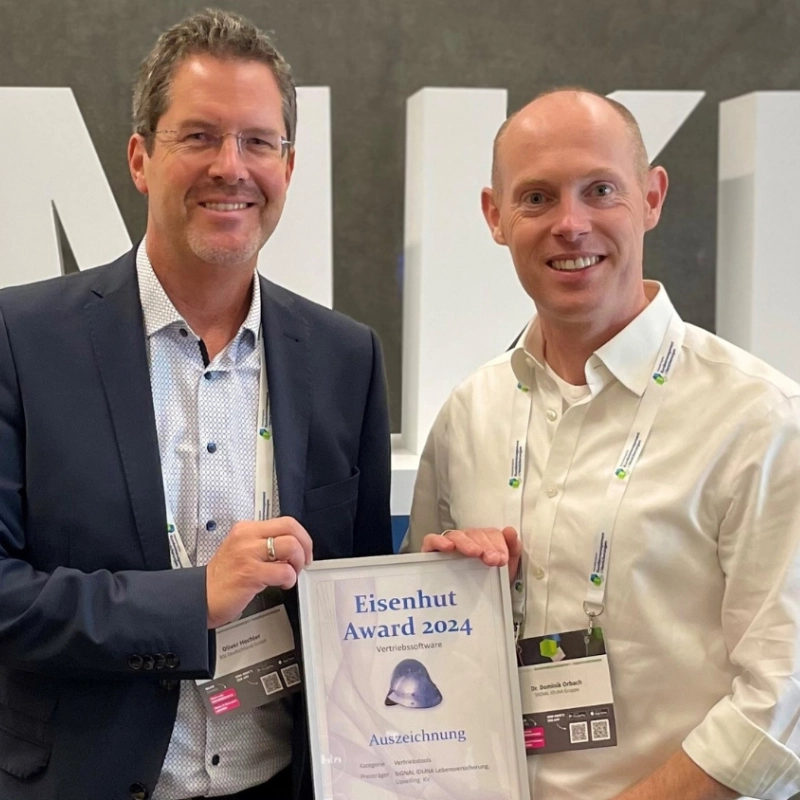
"A 4% conversion rate with a fully automated, on-brand campaign convinced all of us."
The future of CRM goals: What’s changing
The core goals of customer relationship management remain the same: retain customers, delight them, and drive revenue. What is changing is the way these goals are achieved.
AI is fundamentally reshaping the customer journey: In the future, it will no longer be pre-orchestrated but generated dynamically. AI agents will operate on behalf of the company, autonomously gathering information, making decisions, and creating individualized, context-adaptive experiences in real time.
Data sovereignty is becoming a competitive advantage. Processing data in non-European clouds creates regulatory and strategic dependencies. Companies that rely on European solutions with the highest data protection standards and a model-agnostic multi-cloud strategy are better positioned for the EU AI Act, for GDPR, and for earning their customers’ trust. Digital sovereignty goes beyond compliance: It’s about full control over data and technology, independent of geopolitical developments and the business conditions of U.S. hyperscalers. For banks and insurers, this is a regulatory necessity.
From CRM to Agent Relationship Management (ARM): Customer interactions will increasingly take place not directly with end customers, but with their personal AI assistants. Companies that intentionally design this new relationship layer gain a clear advantage: in trust, in relevance, and ultimately in achieving conversions.
Sales, service, and marketing are becoming one. The boundaries between traditional functions are fading. The companies that win are those that think in end-to-end scenarios and customer values, not in isolated projects.
Responsible AI is becoming a requirement. With the EU AI Act, the guardrails are set. Companies need CRM platforms that deploy AI not only effectively but also ethically and in full legal compliance. BSI Software established its own Code of Conduct for AI back in 2023 to ensure exactly that.
Conclusion: CRM goals as a foundation for sustainable business success
CRM goals are the strategic compass for any company aiming for long-term growth. The key takeaways:
- Goals without measurability are aspirations. Only clear KPIs turn intentions into a viable CRM strategy.
- A shared understanding across marketing, sales, and service is essential. Silos are the biggest enemy.
- AI is changing the rules of the game. Companies that do not leverage AI-driven automation and personalization today will lose customers tomorrow to competitors who do.
- Data sovereignty is not a nice-to-have. Especially in regulated industries, it is a strategic advantage.
- The platform makes the difference. It’s not the best standalone tool that wins, but the integrated solution that connects sales, marketing, and service into a seamless experience.
Many companies fail not because of the technology, but because they lack integration into their organization and processes. Current studies confirm this: It is not the model that fails, but its embedding in day-to-day operations. Companies that consistently pursue their CRM goals and implement them with the right CRM/CX platform create customer loyalty that lasts.
What do successful CRM goals look like in practice? Explore specific use cases, real-world examples, and solution approaches on the BSI Customer Suite page and discover what becomes possible with an integrated CRM/CX platform. Or experience BSI firsthand:
