What you will find in this article

  • Why companies are looking for alternatives to Salesforce 
  • Requirements for a solid software alternative to Salesforce 
  • Salesforce alternatives at a glance 
  • Why European CRM solutions are a true alternative 
  • A closer look at the alternative made in Europe: The BSI Customer Suite 
  • Implementation: How to ensure a successful transition away from Salesforce
  • Cost, ROI, and efficiency compared 
  • Conclusion: When choosing an alternative to Salesforce makes sense 
  • FAQs: Frequently asked questions about Salesforce alternatives

Why companies are looking for alternatives to Salesforce

While Salesforce is a powerful solution, many companies encounter limitations with respect to its cost, complexity, and dependency that limit long-term flexibility and the ability to plan.

High licensing and operating costs

Salesforce entices with appealing introductory prices but quickly becomes expensive due to confusing billing units such as "Super Messages," add-ons, and rising license costs year over year. In the long term, Salesforce is at the upper end of the market in terms of total cost of ownership (TCO).

Complexity and high administrative effort

Salesforce consists of separate clouds (Sales Cloud, Marketing Cloud, Service Cloud) that are quickly set up for standard implementations. However, as soon as individual adaptations are necessary, the complexity increases significantly: The solution’s fragmented architecture requires labor-intensive cross-cloud integration, creates data silos, and makes workflows inefficient. Individual adaptations often require developer resources.

Dependency on the Salesforce ecosystem

Salesforce offers more than 6,000 connected third-party apps, but many of them process data outside of Europe. In the long term, a vendor lock-in is created: Customers are strongly tied to Salesforce infrastructure, APIs, and processes, making it increasingly challenging for them to switch.

Requirements for a solid software alternative to Salesforce

Not every alternative CRM solution is automatically the better choice. Four criteria make the decision easier:

Rapid implementation and user-friendliness

A desirable alternative ought to be fast to deploy, without months-long projects and complicated development work. Intuitive usability and preconfigured industry solutions make teams productive from day one – rather than stuck in training sessions and ticketing systems.

Flexible adaptations without extensive development work

Rigid standard features rarely align with individual business processes. A robust CRM solution, on the other hand, can be configured through no code or low code, eliminating the need for additional developer capacity. Preconfigured industry solutions speed up the implementation even further.

GDPR Compliance and data control

The regulatory requirements for companies are constantly increasing. A viable alternative to Salesforce should offer more than GDPR compliance: It ought to ensure full data sovereignty through European data centers and legal frameworks, thereby guaranteeing independence from U.S. legislation.

Scalability to support different business sizes

As your company grows, the CRM platform must be able to grow with it, without driving exponential cost increases. A true alternative should scale with rising user numbers, transactions, and integrations while remaining fully transparent: with no hidden fees and no sudden price spikes.

Salesforce alternatives at a glance

If you are looking for alternatives to Salesforce, you will find a wide range of CRM solutions, ranging from international platforms to specialized vendors. However, not all of them meet the needs of European companies.

CriterionSalesforceThe BSI Customer Suite
Data hostingGlobal, often US-relatedEurope
GDPR compliancePossible, but additional compliance review requiredStandard
Pricing structureRigid editionsModular, flexible scaling
Implementation effortHighLow to medium
Industry solutionsPartly through partnersPreconfigured
Marketing, sales & serviceMultiple cloudsAn integrated suite
AdaptationsOften requires customer-side development workNo code/low code

Salesforce vs. the BSI Customer Suite: Key differences

  • European data sovereignty instead of U.S. cloud dependency 
  • Unified platform instead of multiple clouds 
  • Transparent pricing instead of complex licensing models 
  • Preconfigured industry solutions instead of extensive custom projects 
  • No code/low code instead of high development effort

International providers (e.g., HubSpot, Zoho)

  • Rapid implementation and marketing focus with clean user interfaces
  • But: limited enterprise functionality and data-protection concerns similar to Salesforce

Open-source and flexible solutions (e.g., SugarCRM)

  • Maximum flexibility and full control of code and infrastructure
  • But: significant development effort, long-term maintenance, and in-house IT skills required

European CRM alternatives with a focus on data protection (e.g., the BSI Customer Suite)

  • GDPR compliant, European data centers, complete data sovereignty
  • Often a significantly deeper level of industry specialization
  • Transparent pricing structure and no hidden fees
  • Local support rather than impersonal global ticketing systems

Why European CRM solutions are a true alternative

Although global platforms dominate the market, local providers are increasingly becoming a strategic option for companies in Europe. Why? Because they combine technological performance with regulatory security and true customer proximity.

Data protection and data hosting in Europe

European CRM providers operate data centers in the EU and Switzerland and are fully governed by European law. This means no data access by U.S. authorities, no CLOUD Act exposure, and full control over sensitive customer data. This aspect is especially critical for banks, insurance companies, and other regulated industries.

Transparency and regulatory security

Instead of complex licensing models with hidden add-on costs, European vendors offer transparent pricing structures and predictable total costs. Regulatory requirements such as GDPR, DORA or BaFin requirements are not added retroactively but are built into the product development process and architecture from the very beginning.

Local expertise and support

Direct, local contacts instead of impersonal global ticket systems, personal support instead of standardized onboarding programs, and true industry expertise instead of generic CRM functions: European providers focus on partnership-based collaboration and rapid response times, without relying on third-party intermediaries.

A closer look at the alternative made in Europe: State-of-the-art CRM platforms like BSI

The BSI Customer Suite is not just any Salesforce alternative. It is the stronger solution, particularly for companies in banking, insurance, retail, and energy & utilities that view industry expertise, data sovereignty, and flexibility as standard requirements rather than optional add-ons.

Holistic customer relationship management

The BSI Customer Suite provides a 360° customer view in real time – across all channels, touchpoints, and processes. With BSI Elements, you get preconfigured industry solutions that directly map key customer journeys, KPIs, and regulatory requirements and are ready out of the box.

Learn more about our industry solutions for Banking, Insurance, Retail und Energy & Utilities.

Sales, marketing, and service on a single platform

A true suite, built as one: one data model, one UI, no data silos, no breaks. Unlike Salesforce, BSI is seamless across the entire customer journey. AI is embedded directly into the platform, with no retrofitted add-ons. It is up to you, not the AI agent, to decide which tasks AI gets to do and which remain under human control.

Explore the BSI Customer Suite for end-to-end customer journeys.

Seamless integration into existing system landscapes

With BSI’s Enterprise Integration Platform, you can integrate third-party systems quickly and reliably. The data model can be neatly modified and extended to align with the requirements of the surrounding systems. Once integrated, all data is available in real time throughout the entire suite.

Maximum flexibility without complex development work

In the BSI Customer Suite, more than 95 percent of all adaptations can be implemented via no code or low code. Every change will automatically take effect everywhere: in searches, reports, workflows, and in AI. With Salesforce, by contrast, many adaptations require custom development.

Discover the BSI Customer Suite in detail.

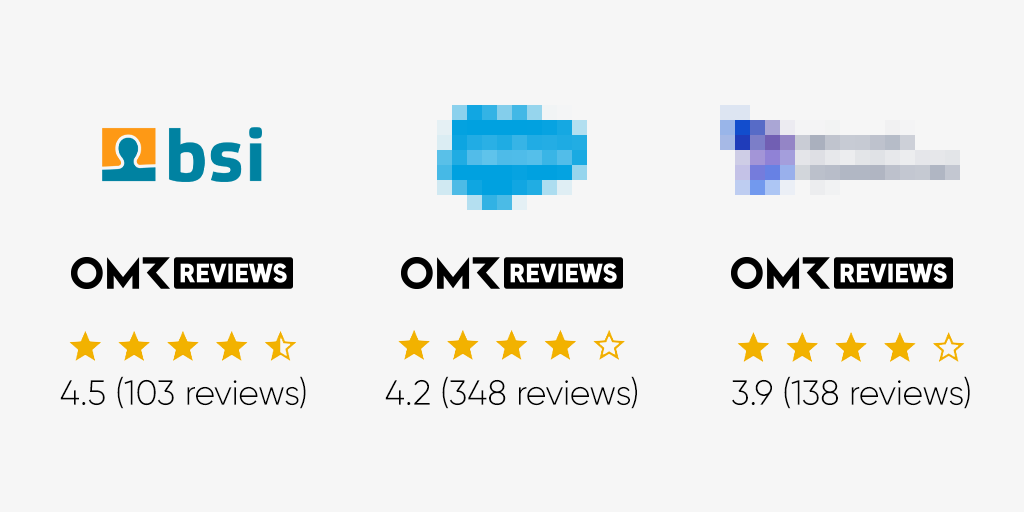
BSI is among the top-rated CRM providers on OMR Reviews with 4.5 out of 5 stars from more than 100 reviews. Comparison graphic showing customer ratings and reviews of various software providers on OMR Reviews.

Implementation: How to ensure a successful transition away from Salesforce

Companies transitioning away from Salesforce typically seek less overhead, shorter time-to-value, and greater control. BSI Software supports you from day one with a structured approach that interlocks technical migration, organizational change, and technical introduction.

Data migration and system integration

The move out of the Salesforce cloud is orchestrated through a controlled data transfer: Customer data, sales pipelines, campaign histories, and service tickets are fully migrated. Existing third-party systems connect to the BSI Enterprise Integration Platform via standardized interfaces – no developer capacity needed. The result is a seamless system that goes live fast and without data loss.

BSI Customer Suite for ADAC

One of the largest data migration projects ever done in Germany

The transfer from the previous, host-based core system to the BSI Customer Suite was done over a long weekend and involved the successful migration of more than 600 million data records – one of the biggest data migrations in Germany to date.

ADAC headquarters with a modern yellow and grey glass facade symbolizing Germany’s largest data migration to the BSI Customer Suite. The image represents digital transformation, customer relationship management, and future-oriented IT infrastructure.

Minimizing complexity throughout the transition

Rather than starting from scratch, you can leverage BSI Elements, which are preconfigured process building blocks for sales, service, and marketing, tailored to industry requirements. This lowers the adaptation effort, accelerates the project timeline, and reduces risk: You start with proven processes instead of custom development.

Change management and training

As the system is being prepared technically, you train your teams directly in the new environment: with real use cases, industry relevance, and hands-on practice instead of lengthy theory. This builds buy-in, removes barriers, and ensures productivity on day one.

Cost, ROI, and efficiency compared

Sound business decisions require transparency, planning ability, and sustainable value creation. Especially with CRM systems, it is not the list price that matters but the total cost over the system’s lifetime.

License cost vs. total cost: Transparency instead of hidden fees

Salesforce entices with appealing introductory prices, but fictional metrics such as “Super Messages” as well as extra fees for data storage and add-ons quickly drive up the overall spend. BSI Software offers flexible pricing with full cost transparency, predictable expansion options, and zero usage-based surprises. Even as user numbers grow, the overall cost level remains predictable and stays significantly below that of Salesforce in the long term.

Lower complexity, higher savings

Salesforce’s fragmented cloud architecture drives up the integration effort and creates ongoing extra costs. The BSI Customer Suite delivers a truly unified suite, seamlessly connecting marketing, sales, and service without any interfaces. This reduces the implementation effort as well as ongoing operating costs.

Faster value creation

On average, the BSI Customer Suite is 50 percent faster to start than the previous standard and 30 percent faster to implement than the next best alternative. Simply import preconfigured industry solutions as BSI Elements with just a few clicks. The platform delivers true added value from day one – not after months of custom development.

Conclusion: When choosing an alternative to Salesforce makes sense

While Salesforce dominates the CRM market, that doesn't automatically make it the best solution for your business. European providers like BSI Software incorporate all of the following:


  • Integrated Suite: marketing, sales, and service on a single platform, with no add-on modules
  • Transparent pricing models: no hidden fees, predictable total cost
  • Rapid implementation: preconfigured industry solutions instead of months of custom development
  • European data sovereignty: GDPR-compliant, full control over your data

Decision support for companies

A Salesforce alternative becomes especially worthwhile when transparency, integration capability, industry specialization, data sovereignty, and rapid time-to-value are your key requirements.

Next steps toward choosing the right CRM solution


Are you ready to make the transition? Test the BSI Customer Suite.

Experience BSI
Customer consultant Vicky with telephone - signals direct contact via BSI Software.

FAQs: Frequently asked questions about Salesforce alternatives

Are there European alternatives to Salesforce?

Yes, there are. The BSI Customer Suite is fully developed, hosted, and operated in Europe: GDPR-compliant, free from the U.S. Cloud Act, with preconfigured industry solutions for banking, insurance, retail, and energy & utilities, plus more than 70 AI models to choose from.

Which Salesforce alternative is the best one?

It depends on your priorities. The BSI Customer Suite offers an integrated platform (marketing, sales, service all in one), flexible pricing instead of hidden fees, preconfigured industry solutions (banking, insurance, energy & utilities, retail), and rapid implementation. This makes it a perfect fit for European companies in regulated industries.

Why are companies moving away from Salesforce?

Common reasons include high list prices, opaque transaction fees, fragmented clouds requiring significant integration across sales, marketing, and service, lengthy implementation timelines, and insufficient industry specialization. European alternatives offer transparent TCO, faster time-to-value, and GDPR compliance without exposure to the US Cloud Act.

Which CRM systems are priced lower than Salesforce?

From a long-term perspective (TCO), BSI is significantly more cost-effective thanks to concise, easy-to-understand licensing terms, modular scalability, the absence of editions with features you don’t need, and the holistic integration of marketing, sales and service. Plus, there are no fictional metrics such as “Super Messages” and no hidden fees.

Salesforce: Who it fits and who it doesn’t?

Salesforce is well-suited for global organizations with substantial IT budgets and a U.S. focus. BSI Software is the stronger option for European companies in regulated industries (such as banking, insurance, and energy) with more than 100 users and over 100,000 customers, seeking fast implementation, transparent cost structures, and full GDPR compliance.

Two stylized figures shake hands - a symbol of personal contact via the BSI Software website, partnership-based communication and active customer proximity.

Talk with us

We would be happy to assist you at any time.