29.06.2026

Data sovereignty in CRM

Why data control is becoming a strategic competitive advantage

Customer data is now one of the most valuable assets a company possesses. Organizations that know exactly where their data resides, who can access it, and under which jurisdiction it is processed lay the foundation for genuine trust. And increasingly, end customers choose companies they trust to keep their data safe.


Therefore, managing customer data has become a leadership-level decision. Data sovereignty in CRM determines whether companies can meet regulatory requirements such as GDPR, DORA, and the EU AI Act, while still delivering AI-enabled customer experiences that truly delight customers. Both are only possible when the right foundation is in place: full control over secure customer data, transparent data processing, and a CRM platform built on digital sovereignty. Companies that take this seriously today will secure a measurable competitive advantage tomorrow.


Modern data center with rows of high-performance server racks in a secure, climate-controlled environment. Symbolizing European data flows in CRM, digital sovereignty, and data residency within the EU. Modern data center with rows of high-performance server racks in a secure, climate-controlled environment. Symbolizing European data flows in CRM, digital sovereignty, and data residency within the EU.

What is data sovereignty in CRM? – A definition

Data sovereignty in CRM is a strategic concept that enables companies to maintain full control over their customer data by combining technological independence, legal clarity, and operational autonomy.

The difference between data protection, compliance, and data sovereignty

Data protection safeguards personal data against unauthorized access. Compliance in CRM ensures that legal requirements are met. Data sovereignty goes further: It describes the ability to decide for yourself where data is stored, how it is processed, and which technologies are used to do so. If you are only GDPR-compliant, you have met the minimum requirement. Yet if you are digitally sovereign, you retain control, even as laws, vendors, or geopolitical conditions change.


  • Data protection: safeguarding personal data, ensuring security, and maintaining legal compliance
  • Data sovereignty: strategic control, data autonomy, governance, and full control over infrastructure and AI systems

Why data sovereignty is becoming strategically critical for companies

The risks arising from cloud dependencies and vendor lock-in

Many companies today rely on cloud infrastructures provided by US hyperscalers. That is understandable: Their performance is strong, and so is their scalability. But the dependency comes at a price. U.S.-based providers are subject to U.S. law, even when their data centers are located in Europe. The CLOUD Act allows U.S. authorities to access data under certain circumstances, regardless of the location of the server. For banks, insurers, and energy providers in the DACH region, this represents both a regulatory and a strategic risk.


Then there’s the topic of vendor lock-in: Companies that have made substantial investments in proprietary systems lose the ability to make technological decisions autonomously.


  • Vendor lock-in: limited technological flexibility
  • Data access by third countries: CLOUD Act-related compliance risks
  • Dependence on individual hyperscalers: strategic risks amid geopolitical conflicts
  • Non-transparent AI models: loss of trust among customers

Why AI is changing the requirements for data control

AI IN CRM: AI-enabled CRM platforms are processing more customer data than ever before, in real time, across all channels, and with increasing autonomy. AI agents analyze interactions, make decisions, and manage campaigns. They define the next best action in sales, identify customers who are on the verge of churning, or orchestrate service routing in the contact center. This makes data sovereignty a prerequisite in any CRM platform. The more autonomously AI agents operate, the more pressing the question becomes: Who made this decision, on what data basis, and is it reproducible? The EU AI Act mandates transparency. Companies that adopt model-agnostic, auditable AI systems today will be better positioned tomorrow – both regulatorily and strategically.

Regulatory requirements companies must meet today

GDPR, the EU AI Act, and industry-specific requirements

The regulatory landscape in the DACH region is demanding, and it is becoming stricter. Three regulatory frameworks define the boundaries:


  • GDPR in the CRM system: The foundation for protecting personal data. Mandatory for any company processing customer data in the EU.
  • The EU AI Act: A risk-based framework for the deployment of AI. Transparency and human oversight are mandatory, especially for high-risk applications.
  • DORA: The Digital Operational Resilience Act. Mandatory for banks and insurers. Requires demonstrable resilience of IT infrastructure, including in relation to third-party providers.

Why regulated industries are particularly affected

Banks, insurers, and energy providers process highly sensitive customer data – account movements, insurance histories, consumption data. At the same time, the pressure to introduce AI-enabled processes to remain competitive is intensifying. Any organization that wants to combine both needs a CRM platform that treats regulatory compliance and innovation as a single, integrated capability.

How European CRM software gives companies greater control

European cloud infrastructure

Data sovereignty does not mean foregoing external service providers. Rather, it means defining the terms of collaboration yourself. A multi-cloud strategy based on European cloud service providers gives companies exactly that: technological freedom of choice without strategic dependency. Open architectures with standardized interfaces make it possible to swap out components without putting the overall system at risk. Modularity is the foundation of exit capability: the ability to reverse technological decisions when requirements or conditions change.

Responsible AI and transparent data processing

Responsible AI is the prerequisite for ensuring that AI-enabled CRM processes perform reliably and in the long term and gain acceptance. AI governance: Companies that anchor AI governance as a binding framework for the deployment, control, and traceability of AI systems within their platform strategy establish the foundation for scalable, trusted customer experiences.

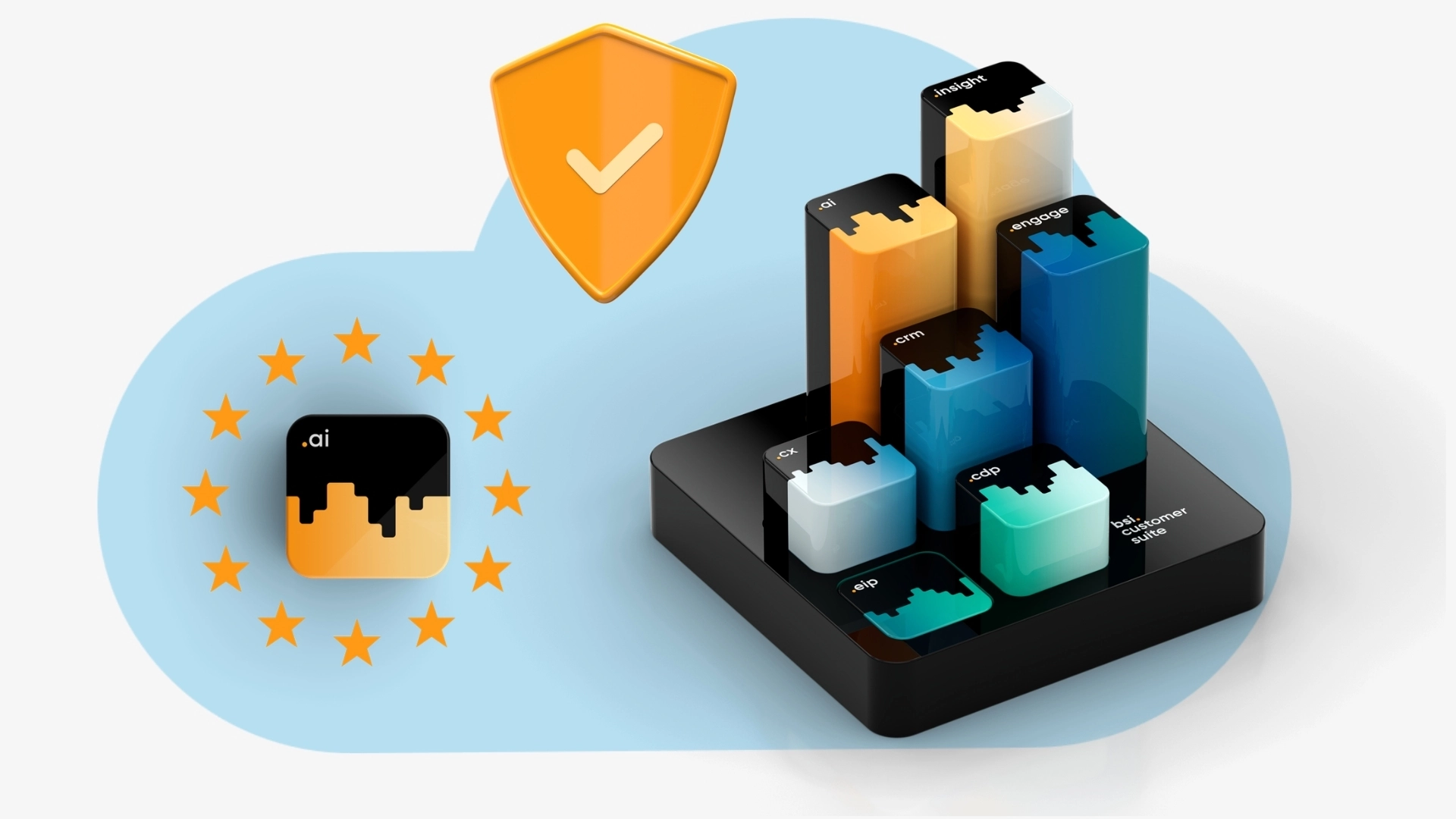
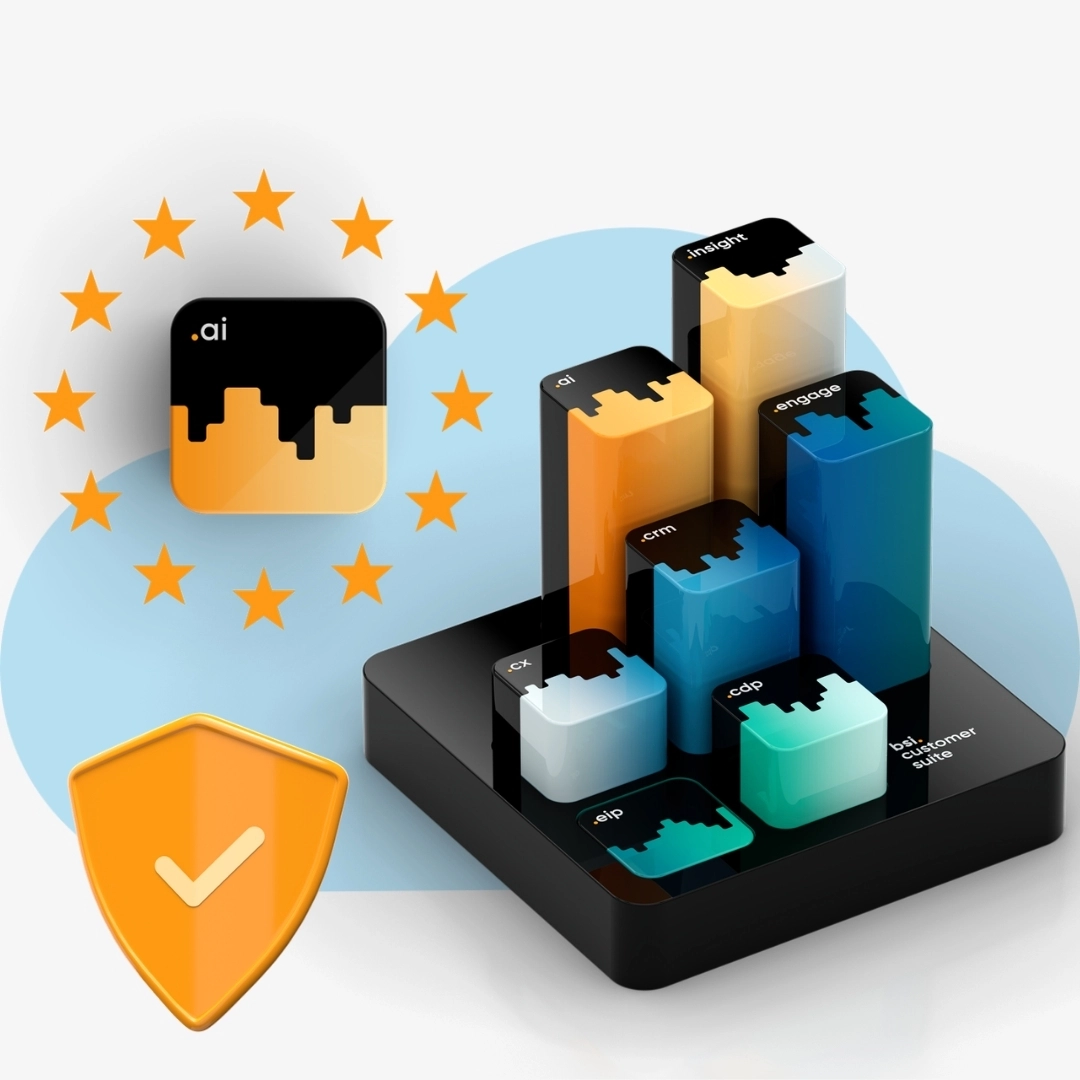
CRM/CX Platform with AI and Data Privacy – European cloud architecture for secure customer data CRM/CX Platform with AI and Data Privacy – European cloud architecture for secure customer data

The BSI Customer Suite is the only holistic CRM and CX solution made in Europe with deeply integrated AI that ensures data protection, sovereignty, and flexibility at the same time.

Why data sovereignty is becoming a competitive advantage

Trust as a success factor in customer experience

“Companies that not only promise trust but put it into practice gain customers, partners, and long-term market opportunities.” Markus Brunold, CEO of BSI Software. Customers who know that their data is managed securely and with full sovereignty are more loyal, recommend more readily, and switch less frequently. In a world where customer experience determines market share, data sovereignty in CRM becomes a CX imperative.

Data sovereignty as the foundation for sustainable AI strategies

AI strategies without full data control rest on an unstable foundation. Without clarity about where data resides, who can access it, and under which legal framework it is processed, AI systems can neither be reliably governed nor secured from a regulatory standpoint. Data sovereignty provides precisely this foundation, and with it, an advantage over competitors who still need to establish that level of control.

How BSI Software supports companies in achieving digital sovereignty

The BSI Customer Suite, a CRM/CX platform made in Europe

The BSI Customer Suite is the only fully integrated CRM/CX software platform built in Europe with deeply embedded AI that ensures data protection in the CRM platform, digital sovereignty, and maximum flexibility at the same time. It is GDPR-compliant, ISO-certified, and meets the regulatory requirements for banks, insurers, and energy providers in the DACH region, including DORA and the EU AI Act.


In the first quarter of 2026, BSI Software entered into a partnership with T-Systems for the use of the T Cloud. This partnership enables BSI customers to move to a purely European cloud SaaS solution: All data remains in Europe, is subject to European law, and is shielded from access by third countries.

Markus Brunold, CEO, BSI Software

“Digital sovereignty means that companies can keep their customer data in Europe while also leveraging leading AI.” 

Markus Brunold

CEO, BSI Software

What BSI Software delivers:


  • Model-agnostic design: Select from more than 70 AI models that can be swapped within 90 minutes. The result? No vendor lock-in. 
  • Cloud-agnostic design: A multi-cloud strategy with European cloud service providers, including T-Systems’ T Cloud. Migration is possible within 72 hours.
  • Open architecture: Transparent open-source foundation with open APIs. No proprietary dependencies.
  • Responsible AI: BSI developed its own AI Code of Conduct in 2023 and holds the Data Fairness Label. Human-in-the-loop is a living design principle and a regulatory requirement at the same time.

Conclusion: Data sovereignty is more than compliance

Data sovereignty in CRM is the prerequisite for trusted, AI-enabled customer experiences. Key takeaways:


  • GDPR compliance in the CRM platform is the minimum standard. Digital sovereignty is the strategic advantage.
  • AI raises the bar: more data, more automation, more responsibility.
  • European CRM software offers technological independence without sacrificing innovation.
  • End customers increasingly ask – proactively and explicitly – where their data is stored. Trust becomes a differentiating factor.
  • Those who make data-sovereign decisions today will remain capable of acting tomorrow.


Data sovereignty is no longer an IT topic. It has become the prerequisite for trusted customer experiences and successful AI strategies.

FAQs

Straightforward answers on data sovereignty in the CRM platform

What does data sovereignty in the CRM platform mean?

Data sovereignty within the CRM platform means that companies retain full control over where their customer data is stored, how it is processed, and which technologies are used – independent of vendor constraints or geopolitical developments.

Why isn’t GDPR compliance on its own enough?

GDPR governs the protection of personal data. It does not determine whether a company is technologically independent or whether it can retain control over its infrastructure in a crisis. Data sovereignty goes beyond that.

What risks arise from using international cloud providers?

U.S.-based providers are subject to U.S. legislation, even when operating data centers located in Europe. Under the CLOUD Act, authorities may gain access to data under certain conditions. There is also the risk of vendor lock-in: limited flexibility and high dependency.

Why is data sovereignty becoming more important with AI?

AI systems process larger volumes of data, make more autonomous decisions, and are subject to stricter regulatory requirements. To use AI in the CRM platform with full sovereignty, companies need control over their models, their data, and their underlying infrastructure.

What advantages do European CRM platforms offer?

CRM platforms made in Europe provide legal clarity, technological independence, regulatory certainty, and the ability to build AI strategies on a stable, fully controlled foundation.